Ever notice some of the comments people threw around 60 years ago are now totally inappropriate by today's standards?
El Paso's finest.
Thursday, December 12, 2013
Motorcycle Dyno
Prior to seeing this drawing it never really occurred to me that the origin of ft-lbs was so literally a measurement involving feet (as in 12"). You learn something new every day.
Wednesday, December 11, 2013
Speedbird Update
As you may have previously noticed, my pal English Stephen is incredibly (obsessively perhaps) detail oriented. He has been working on a custom dimensioned rigid rear frame section for quite a while now. He requires both non-standard length and angles to obtain the desired stance he is going for. He is also insistent the frame section look as much as the original factory piece as possible. Custom angles mean he cannot just "reuse" the stock dropout castings.
He spent considerable time creating molds to cast the one-off piece. He then spent significant time and money having the castings poured. After a fairly long wait he received the castings and ultimately decided the quality would not meet his standards. He opted to start over from scratch.
He started by designing the new casting in Solidworks, itself not a trivial feat. He then took that design and printed it on a 3D printer. What a stunning part.
Stephen made some subtle changes to the part and asked me if the new design was loyal enough to the stock casting. I assured him it was. The following is the "printed" part. Simply stunning. Next comes the finished product in steel.
So, what would Edwin Turner himself think about all this newfangled technology from a purely craftsmanship perspective? I think this paragraph from Clew, Jeff (2012-01-19). Edward Turner – The man behind the motorcycles might help to form an opinion:
One of the younger staff who had interviewed for employment with the new Triumph company was Jack Wickes, aged 21. His job began as print boy, which involved delivering blueprints to all the different departments. Jack later transitioned into a new role turning Edward’s sketches into general schemes and sometimes into full colour illustrations. He also submitted his own ideas for approval which, if completed in the office and accepted, could be seen on future production models. His design of the now familiar Triumph headlamp nacelle is just one example. A very good working relationship developed between the pair; Jack had a high regard for his boss who, although not a qualified engineer, was a very shrewd person. Edward would often refer affectionately to Jack as “my pencil”, an understatement if ever there was one!
In my opinion Edward would have been just fine with applying the technology.
He spent considerable time creating molds to cast the one-off piece. He then spent significant time and money having the castings poured. After a fairly long wait he received the castings and ultimately decided the quality would not meet his standards. He opted to start over from scratch.
He started by designing the new casting in Solidworks, itself not a trivial feat. He then took that design and printed it on a 3D printer. What a stunning part.
Stephen made some subtle changes to the part and asked me if the new design was loyal enough to the stock casting. I assured him it was. The following is the "printed" part. Simply stunning. Next comes the finished product in steel.
So, what would Edwin Turner himself think about all this newfangled technology from a purely craftsmanship perspective? I think this paragraph from Clew, Jeff (2012-01-19). Edward Turner – The man behind the motorcycles might help to form an opinion:
One of the younger staff who had interviewed for employment with the new Triumph company was Jack Wickes, aged 21. His job began as print boy, which involved delivering blueprints to all the different departments. Jack later transitioned into a new role turning Edward’s sketches into general schemes and sometimes into full colour illustrations. He also submitted his own ideas for approval which, if completed in the office and accepted, could be seen on future production models. His design of the now familiar Triumph headlamp nacelle is just one example. A very good working relationship developed between the pair; Jack had a high regard for his boss who, although not a qualified engineer, was a very shrewd person. Edward would often refer affectionately to Jack as “my pencil”, an understatement if ever there was one!
In my opinion Edward would have been just fine with applying the technology.
Tuesday, December 10, 2013
Cliff Stering
Flathead Rob has met this fine fellow a few times. Cliff is Seattle Cossacks member #38. I believe Rob is #136 since 1938.
Sunday, December 8, 2013
Safer On A Bike
My work life and motorcycle life don't often mix much but risk assessment is a huge part of my job. Having a suitably large sample size is a huge part of the problem. My work world is often similarly influenced by a lack of long term data. This editorial comes from the July 1954 issue of CYCLE magazine.
It would be interesting to run current numbers through the same comparison. Too much like work, I won't be doing it today. Here are however some 2012 stats I found interesting:
So if I do risk assessment for a living, why in the hell do I ride a motorcycle?
Motorcycling advocate Wendy Moon says it this way - "We gradually distance ourselves from experiencing a full and free life and we don’t even know it. As a society, we’re like kids so bundled up against the snow we cannot move at all.... Embracing that risk rejuvenates the soul and empowers one to live the rest of her life as she wants."
Right or wrong I got to a point in life where it occurred to me that living an entirely risk-based life was slowly killing me through boredom. Nearly every story I care to repeat about my life as an adolescent or young adult involves an event that was not triggered by meticulous risk evaluation. Living on two wheels in one way or another was a pretty common component.
That said, please be vigilant out there folks.
It would be interesting to run current numbers through the same comparison. Too much like work, I won't be doing it today. Here are however some 2012 stats I found interesting:
- 75% of accidents were found to involve a motorcycle and a passenger vehicle, while the remaining 25% of accidents were single motorcycle accidents.
- "In the single vehicle accidents, motorcycle rider error was present as the accident precipitating factor in about two-thirds of the cases, with the typical error being a slide-out and fall due to overbraking or running wide on a curve due to excess speed or under-cornering."
- "Almost half of the fatal accidents show alcohol involvement" and "injury severity increases with speed, alcohol involvement and motorcycle size."
- In the multiple vehicle accidents, the driver of the other vehicle violated the motorcycle right-of-way and caused the accident in two-thirds of those accidents.
- The report's additional findings show that the wearing of appropriate gear, specifically, helmets and durable garment, mitigates crash injuries substantially.
- Thirty-five percent of all crashes show major impact on the chin-bar area.
So if I do risk assessment for a living, why in the hell do I ride a motorcycle?
Motorcycling advocate Wendy Moon says it this way - "We gradually distance ourselves from experiencing a full and free life and we don’t even know it. As a society, we’re like kids so bundled up against the snow we cannot move at all.... Embracing that risk rejuvenates the soul and empowers one to live the rest of her life as she wants."
Right or wrong I got to a point in life where it occurred to me that living an entirely risk-based life was slowly killing me through boredom. Nearly every story I care to repeat about my life as an adolescent or young adult involves an event that was not triggered by meticulous risk evaluation. Living on two wheels in one way or another was a pretty common component.
That said, please be vigilant out there folks.
Saturday, December 7, 2013
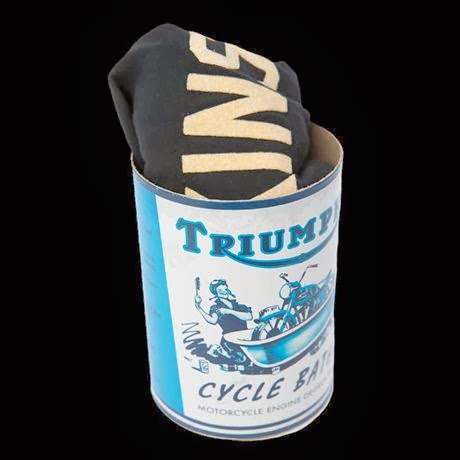
Cycle Bath
Bullitt
Vaughn spotted a Hunter Green '68 Mustang Fastback in a toy store today and insisted it was "Eleanor" (he was simultaneously trying to convince him to buy it for him). I had to show him this video to clarify the significance of the Bullitt Mustang.
I'm only posting this because Flathead Rob's Brandon needs to watch it too for his own reasons.
Tuesday, December 3, 2013
Arena of Death -1937
"This daredevil is balanced on a
block placed on top of the fuel tank of his motorcycle. The motorcycle,
its motor racing, is balanced on two sets of rollers mounted in a
specially designed platform. The "Arena of Death" was just one of the
spectacular sideshows that attracted crowds to the 1937 Puyallup Fair.
For a small fee, fairgoers could watch as the young stunt rider raced
his motorcycle up onto and around the walls of the circular track inside
the building behind him."
The Hirsch Cycle Co., authorized dealers of Harley-Davidson motorcycles and Columbia bicycles, announced a sale of used motorcycles including all makes and models. A Harley-Davidson is shown in the foreground, ridden by a man in a three-piece suit and bow tie. It is possible that the man is store manager C.R. Potter. Hirsch Cycle had moved from its longtime location at 809 Pacific Ave. to 10th & Tacoma Ave. So. by early 1925. It had been in business for about 12 years.
Sixteen motorcycle police officers posed with their "bikes" in front of the Montgomery Motorcycle Company store at 1755 Fawcett Avenue in April of 1948. Willard E. "Monty" Montgomery owned and operated this Harley-Davidson motorcycle shop from 1947 until he died in December of 1963.
Five-year-old Randy Miller, son of Mr. & Mrs. H.W. "Tex" Miller of Tacoma, poses with his own custom built motorcycle in May 1950. The motorcycle was especially designed and built for him by Paul Stockinger and Cliff Sampson, operators of the Indian Cycle Company at 925 Tacoma Avenue South. Randy Miller was the youngest rider in the Memorial Day motorcycle races sponsored by the Tacoma Ducks motorcycle club.
The Hirsch Cycle Co., authorized dealers of Harley-Davidson motorcycles and Columbia bicycles, announced a sale of used motorcycles including all makes and models. A Harley-Davidson is shown in the foreground, ridden by a man in a three-piece suit and bow tie. It is possible that the man is store manager C.R. Potter. Hirsch Cycle had moved from its longtime location at 809 Pacific Ave. to 10th & Tacoma Ave. So. by early 1925. It had been in business for about 12 years.
Sixteen motorcycle police officers posed with their "bikes" in front of the Montgomery Motorcycle Company store at 1755 Fawcett Avenue in April of 1948. Willard E. "Monty" Montgomery owned and operated this Harley-Davidson motorcycle shop from 1947 until he died in December of 1963.
Five-year-old Randy Miller, son of Mr. & Mrs. H.W. "Tex" Miller of Tacoma, poses with his own custom built motorcycle in May 1950. The motorcycle was especially designed and built for him by Paul Stockinger and Cliff Sampson, operators of the Indian Cycle Company at 925 Tacoma Avenue South. Randy Miller was the youngest rider in the Memorial Day motorcycle races sponsored by the Tacoma Ducks motorcycle club.
Monday, December 2, 2013
Tacoma Speedway
I stumbled across some interesting Tacoma Speedway (1912-1922) content recently. It made me curious why you don't often hear much about motorcycles racing there. Until I did some digging I was unaware of the track's somewhat unorthodox shape. I could see how the shape might lend itself more to cars than traditional motorcycle board track racing.
The Tacoma Speedway that is best remembered is a planked board track that was not quite an “oval” but more a planked, square-like semi-road course. Often overlooked is that prior to its construction there were two earlier versions of the speedway, both considered as road courses.
The first version of the Tacoma Speedway was five mile road course used in 1912.
In 1913, the course was reduced to its original five miles to three and a half miles in length, although retaining the basic configuration of the course used the previous year. This was done by moving one leg of the course to the other side of the Lake View community.
During its years of operation between 1912 and 1922, the Tacoma Speedway, located in Lakewood, hosted some of the big names of racing, rivaling the best in the world. The “Who’s Who" of races -- "Terrible" Teddy Tetzlaff, Earl Cooper, Barney Oldfield, among others -- left rubber on that track. Others left their lives. The purse for the five races held in 1912 was a staggering $25,000. (It would be worth $570,000 today!) The grandstands closed in 1922, and the site is now home to Clover Park Technical College.
Tacoma Speedway August 15, 1915 in Tacoma, Washington. Indian rider Earle 'Red' Armstrong crosses the finish line and is greeted by crew and fans.
The Tacoma Speedway that is best remembered is a planked board track that was not quite an “oval” but more a planked, square-like semi-road course. Often overlooked is that prior to its construction there were two earlier versions of the speedway, both considered as road courses.
The first version of the Tacoma Speedway was five mile road course used in 1912.
In 1913, the course was reduced to its original five miles to three and a half miles in length, although retaining the basic configuration of the course used the previous year. This was done by moving one leg of the course to the other side of the Lake View community.
During its years of operation between 1912 and 1922, the Tacoma Speedway, located in Lakewood, hosted some of the big names of racing, rivaling the best in the world. The “Who’s Who" of races -- "Terrible" Teddy Tetzlaff, Earl Cooper, Barney Oldfield, among others -- left rubber on that track. Others left their lives. The purse for the five races held in 1912 was a staggering $25,000. (It would be worth $570,000 today!) The grandstands closed in 1922, and the site is now home to Clover Park Technical College.
Tacoma Speedway August 15, 1915 in Tacoma, Washington. Indian rider Earle 'Red' Armstrong crosses the finish line and is greeted by crew and fans.
Sunday, December 1, 2013
Aero-Race
I had never heard of one of these airplane vs motorcycle race stunts until I saw this 1914 photo posted on the Vintagent FB page recently. Quite a photo.
Serious testicular fortitude required on both parts. One of the Paul's commenters posted this article segment. Not quite the same situation but still interesting.
One of the strangest incidents of motorcycle racing in the early teens. Excelsior Team rider Joe Wolters survives a collision with a biplane at the end of a race at the Elmhurst Motordrome, in San Francisco, CA. on December 10, 1911.
The biplane attempted to land on the Motordrome's infield, but skidded to a stop in Wolters path . Wolters, who was still at race speed, attempted to avoid the aircraft, but struck the propeller breaking it in half. He was thrown from his bike, and was thought to be seriously injured. Wolters was transported to a local hospital, where it was determined he was only dazed by the collision.
One lucky fellow! San Francisco Chronicle December 11, 1911.
Even in a time of Freestyle Motocross and way more capable equipment the airplane/motorcycle race is a stunt that's not outlived its sense of spectacle.
Serious testicular fortitude required on both parts. One of the Paul's commenters posted this article segment. Not quite the same situation but still interesting.
One of the strangest incidents of motorcycle racing in the early teens. Excelsior Team rider Joe Wolters survives a collision with a biplane at the end of a race at the Elmhurst Motordrome, in San Francisco, CA. on December 10, 1911.
The biplane attempted to land on the Motordrome's infield, but skidded to a stop in Wolters path . Wolters, who was still at race speed, attempted to avoid the aircraft, but struck the propeller breaking it in half. He was thrown from his bike, and was thought to be seriously injured. Wolters was transported to a local hospital, where it was determined he was only dazed by the collision.
One lucky fellow! San Francisco Chronicle December 11, 1911.
Even in a time of Freestyle Motocross and way more capable equipment the airplane/motorcycle race is a stunt that's not outlived its sense of spectacle.
Subscribe to:
Posts (Atom)


